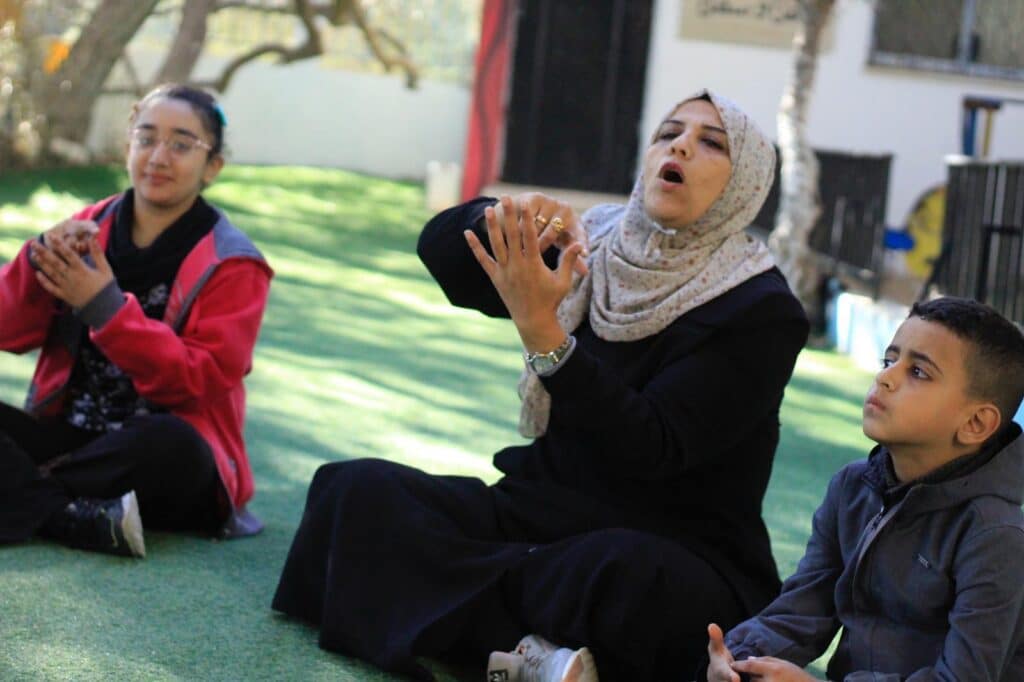
Since May 2024, Amna has trained over 170 frontline workers in Gaza to provide trauma-informed mental health support to communities living through profound grief and loss.
The training also offered frontline workers space to acknowledge their own grief and trauma and equipped them with tools to help themselves and others.
The following reflections from frontline workers who attended Amna’s training sessions:
Raising Flowers from the Rock: Naheel’s Story
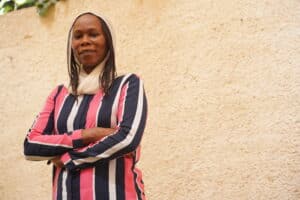
My name is Naheel Mhanna. I am an IT graduate from Al Azhar University in Gaza, but my true passion has always been writing. Over time, writing became more than a dream for me—it became a necessity, a lifeline. I am married and the mother of two wonderful children, a boy and a girl. My journey hasn’t been easy, but it has shaped who I am and the work I do today.
I currently work at Tamer Institute, a place where I finally found alignment between my values and my career. Tamer focuses on culture, literature, and art, using these tools to provide MHPSS for children. Through writing and drawing, we help children find their voices, express their emotions, and regulate their feelings. In our war-torn world, where children are taught to hide their fears and act strong, our work aims to undo this harmful narrative. We encourage them to understand that expressing emotions is not a weakness—it’s human.
Working with children in such a setting brings its own challenges, but it also fills me with a rare sense of purpose and contentment. I have witnessed the impact of what we do, even in the smallest of changes. These moments keep me going, especially during times when everything else feels insurmountable. Writing is not only a tool I use to help others but also a way for me to survive. I write a minimum of 500 words daily for international newspapers, documenting the untold realities of war—the “in-between” struggles that don’t make headlines. These are the daily battles: how to make fire without gas or wood, how to wash clothes by hand, how to find clean water, or how to charge a phone when electricity is non-existent. The war is not just bombs and destruction; it’s also the unyielding grind of survival.
When the Amna training was offered, I hesitated. I didn’t expect much. Honestly, I thought it might be just another theoretical program, distant and disconnected from our reality. But from the first session, I was proven wrong. The structure, the empathy, and the depth of the training were remarkable. It wasn’t just about teaching techniques—it was about helping us process our experiences, connect with ourselves, and find ways to navigate the chaos of our lives.
The training began with identity, which was so meaningful for me. It helped me place myself within the overwhelming context of our situation and understand how to move forward. Then, we tackled trauma, something I live with every day. Learning how our brains instinctively respond to trauma and how our bodies react was eye-opening. It made me realize that the grief and loss I’ve experienced—and the way my mind tries to process it—is not a personal failure. It’s human. The most profound session for me was on grief and loss, which came at just the right time. Like so many others here, I have lost family, friends, my home, and even the sense of safety and routine. The training didn’t just acknowledge our pain; it gave us tools to start processing it.
One exercise I’ll never forget was the Tree of Life. I had used it before, but the way it was presented in the training enriched my approach. The roots symbolized our values and principles, the trunk represented our sources of support, and the branches and fruits reflected our dreams and aspirations. The war has taken so much from us, but this exercise reminded me—and the children I work with—that we can still dream of a better future. Even in the darkest times, we can hold onto hope.
Another exercise I loved was drawing without lifting the pen. It required patience and focus, and for a few precious moments, it took my mind off everything else. I drew my family—my mother, my father, my daughter, and my son—all in one unbroken line. That simple act of drawing became a moment of self-care, a rare gift in my hectic life. I introduced this exercise to my family, friends, and students, and it became a shared experience of creativity and relief.
The trainers, Nasma and Devika, were incredible. Their positive energy and empathy created a safe and supportive environment. They seemed to understand exactly what we were going through, as if they had lived our lives. Their smiles and encouraging presence were like a lifeline, breaking through the isolation we’ve felt during the war. The reflective practice sessions, with their focus on meditation and breathing exercises, were particularly valuable for me. My mind is constantly crowded with thoughts and worries, but these sessions gave me a chance to pause and reset.
Applying what I learned wasn’t without its challenges. The techniques themselves are simple and effective, but building trust with the people I work with is often the hardest part. Many of them have built walls around their emotions, convinced that resilience means hiding their pain. Breaking through those barriers takes time, patience, and understanding. Once that trust is established, the transformation is incredible. I’ve collected over 500 stories from my students—testaments to their courage and resilience.
The war has also taught me resilience, though not without immense pain. My home has been destroyed, and I’m staying with relatives who fled the country. Despite these losses, I’ve managed to hold onto my sanity and redirect my energy toward helping others. This has been my way of surviving, of finding meaning in the chaos.
I often think about the future and the challenges that lie ahead. After the ceasefire, we will face a different kind of struggle—processing the losses we’ve endured and rebuilding our lives. Many people here are afraid to be alone, unable to confront the thoughts and questions that arise in solitude. Others have become fatalistic, leaving everything to fate. It’s a delicate balance, and I hope we can find ways to support each other through it.
The Amna training has been a turning point for me. It has not only equipped me with tools to help my students but has also given me the strength to face my own challenges. It reminded me of the power of connection, creativity, and hope. And for that, I am deeply grateful.
A Volunteer’s Journey: Healing Hearts, Sondos Story
My name is Sondos, and I am not an MHPSS specialist. I hold a master’s degree in law studies, and until recently, my life revolved around a very different world. Now, I find myself volunteering with the Sharek Foundation, teaching English to more than 150 children in North Gaza. It’s been a transformative journey, one filled with fear, hope, and growth, both for the children and for me.
When I first joined Amna’s training, I felt completely out of place. It was my first time participating in an MHPSS training, and I was intimidated. Most of the other participants were experienced humanitarian workers and specialists in the field. I worried I wouldn’t keep up. But as the sessions began, I noticed some familiar faces—former professors from my university—which immediately helped me feel more at ease. And then, when Devika started speaking, her warmth and passion captivated me. The fear melted away, replaced by a growing interest in the subject.
The training quickly became personal for me. Every session sparked ideas on how I could better support my children. I began to think about new ways to engage them, to help them focus, and to encourage them to connect with their peers. Although I’d always sought advice from an MHPSS colleague at Sharek, this training gave me the tools to understand and apply the concepts myself. I became more confident in my ability to help the children regulate their emotions and express their feelings. Each day, I eagerly anticipated the next session, feeling an immense sense of gratitude for the opportunity.
The reflective practice sessions were a gift. Although I rarely spoke during these sessions—still self-conscious about my lack of expertise—I found deep comfort in listening to others. The trainers created a space of empathy and support, offering advice and encouragement to everyone. Their unwavering focus on our well-being was heartwarming, and even as a quiet observer, I felt the positive impact.
After the training, I began applying the techniques in my work with the children. Storytelling became a favorite. I started asking questions that encouraged them to look inward, to share how they felt. I also used drawing techniques. One exercise involved showing the children various pictures and asking them, “Where do you see yourself in this image?” It was incredible to witness how children, who often struggle to articulate their emotions with words, could express so much through art and imagery. Their perspectives were far deeper and more profound than I had ever imagined. These techniques allowed me to understand my children better, to see who needed urgent attention and who could thrive with a little guidance.
There is one child I will never forget. She came to my class late, having migrated from the north with the last group of displaced families. She was from Jabaliya, very young, and had lost her mother during the war. Her father’s whereabouts were unknown, and she was living under her aunt’s care. When she first arrived, she was completely isolated—silent, withdrawn, and unwilling to engage with her classmates.
It was nearly impossible to focus on individual children during class. Our space was small, crowded, and everyone sat on the floor amidst the rubble. But I made an effort to spend time with her after class. I started by asking if she wanted to draw with me. At first, she would scribble aimlessly, using a single color to fill the page with chaotic forms. I realized her drawings mirrored her emotions: unsettled, confused, and distrustful of the world around her.
I didn’t give up. I introduced singing into our time together, inviting her to join me by pretending I’d forgotten the lyrics to a song. Slowly, she began to respond. I told her stories and encouraged her to tell me her own, asking questions about how she would like the endings to unfold. Bit by bit, she began to open up. Eventually, I introduced one or two other children to our after-class sessions, and she started to connect with them. I remember the day she laughed for the first time. It was like a breakthrough—a glimpse of the little girl she could be, free from the weight of her trauma.
Over time, she fully integrated into the class. She made a friend, excelled in her studies, and even passed her English exam with flying colors. Seeing her transformation was a profound moment for me. It affirmed that the techniques I learned in the training were working, even if I wasn’t an expert. She became a star in the class, surpassing her peers in no time. Her success was my therapy. It made me believe in the power of these small but meaningful interventions.
My children—because that’s how I see them—are my joy and my purpose. Every day, they teach me as much as I teach them. Their resilience, their laughter, and their accomplishments, however small, bring light to my life. The hugs I receive when I enter the school, their curiosity about my life as a lawyer-turned-teacher, and their dreams of following in my footsteps—these moments fill my heart with hope.
Amna’s training didn’t just teach me techniques; it gave me the confidence to try, to be present for these children, and to believe that even small changes can make a world of difference. In helping them, I found a way to heal myself too. Together, we are building a small sanctuary of hope, one story, one drawing, and one hug at a time