
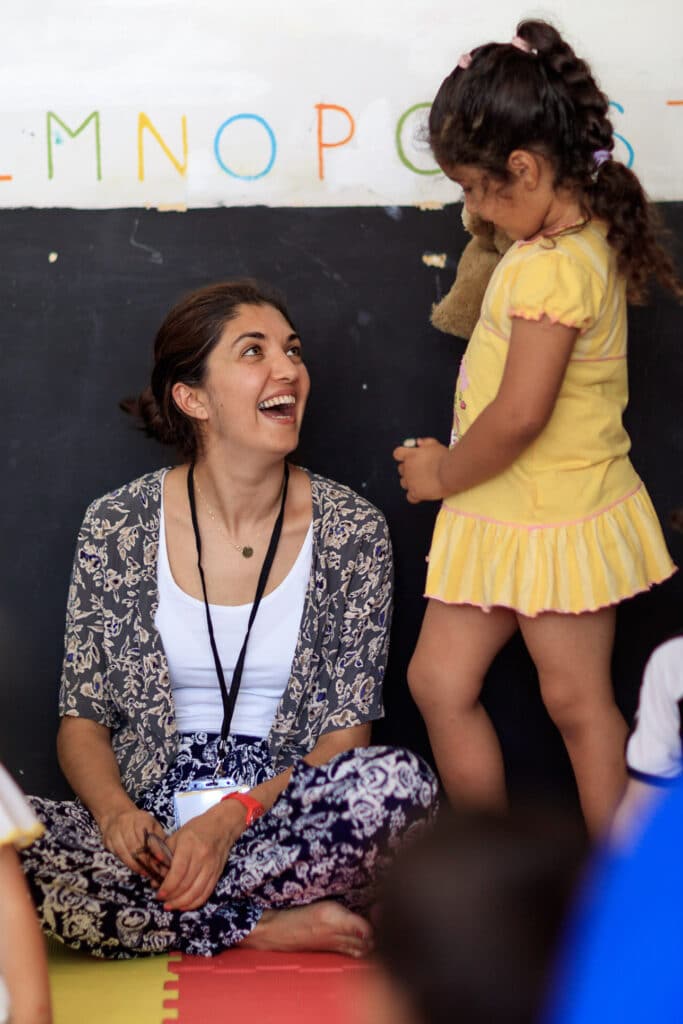
Amna’s story begins in Greece in 2015, where our founder Zarlasht Halaimzai, herself a former refugee, began offering community-based psychosocial support to the refugees arriving after harrowing journeys across the Aegan Sea.
As the crisis deepened in 2016, thousands of refugees found themselves stranded at the borders of Greece and North Macedonia. Zarlasht, along with a small team of counsellors, set up a tent and began offering therapeutic group sessions for men, women, and children. Recognizing the urgent need for long-term mental health support, they cofounded Refugee Trauma Initiative (RTI)the organization that would later become Amna.
Over the next few years, as refugees continued to arrive, our work grew to meet the needs of displaced communities in Greece. Working together with refugees and psychosocial experts, we developed our current programming–nonclinical community-based interventions that help make people who have experienced violence and forced displacement feel safe again.

Our methodology is simple, and evidence-based-we create safe and playful spaces where people can convene and heal as a community. Our aim is to provide care as early as possible to break the cycle of intergenerational trauma, that can affect individuals and communities for a long time.
By 2019, our work was recognised by the WHO and the UN as a best-practice model, and we began scaling by partnering with local organisations. Since then, we have expanded beyond Greece, supporting displaced communities in 23 countries across MENA, Europe and Asia, including in Afghanistan and Ukraine.
What began as direct support in Greece has grown through partnerships with communities, local organisations and practitioners across different contexts of conflict and displacement.
These relationships have shaped our next chapter. Training matters, but so does what happens afterwards: the support to apply learning, the space to reflect, the wellbeing of practitioners and the connections that allow people to learn from one another.
Our Healing Ecosystems approach builds on this foundation. We are working towards more connected, locally led networks of care, where healing-centred practice becomes part of everyday community life and organisational culture—not only a time-limited programme.
Since 2016, Amna and our partners have directly reached more than 114,000 people through community-based support and practitioner development, including 33,234 people between January and September 2026. Our wider estimated reach extends beyond direct participation through the sharing of practices, institutional work and public engagement; it is measured separately from direct support.